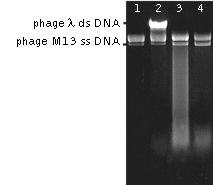
 | Action of DSN on ss DNA of phage M13 and ds DNA of phage λ.
Lanes 1, 2 – negative controls, incubation without nuclease. Lane 1: phage M13 DNA alone, Lane 2 – mixture containing phage M13 and λ DNA. Lanes 3; 4 – digestion of phage M13 and λ DNA mixture by DSN at 70°C for 1.5 min (lane 3) and 5 min (lane 4).
|
|---|
Analysis of DSN activity on synthetic oligonucleotide substrates revealed that the enzyme discriminates between perfectly matched short DNA-DNA duplexes (10-12 bp) and duplexes of the same length with at least one mismatch. It requires at least 10 bp DNA or 15 bp DNA-RNA perfect duplex for cleavage.
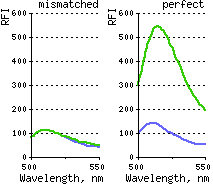 | DSN action on one mismatch-containing and perfectly matched DNA duplexes.
Duplexes formed by 5-carboxyfluorescein (Fl)-5'-gccctatagt-3'-TAMRA signal probe and complementary targets (5’-actcactataCggcgaat-3’ and 5’-actcactatagggcgaat-3’) were incubated with DSN at 35°C for 15 min. Emission spectra were obtained on the spectrofluorimeter, with excitation at 480 nm. Dotted line – substrate fluorescence in the absence of enzyme; firm line – substrate fluorescence after incubation with DSN.
|
|---|