|
||||||||
![]() |
||||||||
![]() |
![]() |
![]() |
![]() |
![]() |
![]() |
![]() |
![]() |
![]() |
|
RNA-i test vector, p2FP-RNAicat.# FP981
Multiple cloning site
* - not unique site Descriptionp2FP-RNAi vector is a mammalian expression vector encoding two fluorescent proteins: TurboGFP and JRed-neomycin phosphotransferase II protein fusion (JRed-Neor). Both proteins are under the control of immediate early promoter of cytomegalovirus (PCMV IE): the first regulates TurboGFP expression, while the second provides JRed-Neor expression. Codon usages of both reporters are optimized for high expression in mammalian cells (Haas et al., 1996). To increase TurboGFP mRNA translation efficiency, Kozak consensus translation initiation site is generated upstream of TurboGFP coding sequence (Kozak, 1987). Multiple cloning site (MCS) is located between the TurboGFP stop codon and SV40 polyadenylation signals (SV40 poly A) allowing to clone a DNA fragment of interest into the TurboGFP 3' untranslated region (3'UTR). SV40 poly A direct proper processing of the 3' end of TurboGFP mRNA.
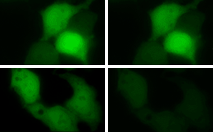
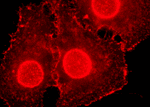
The vector backbone also contains pUC origin of replication for propagation in E. coli, and f1 origin for single-stranded DNA production. Bacterial promoter (PT5/LacO) allows the expression of kanamycin resistance gene (fusion with JRed) in E. coli. Kanr/Neor-JRed fusion gene is linked with herpes simplex virus (HSV) thymidine kinase (TK) polyadenylation signals. Expression in mammalian cellsThe vector can be transfected into mammalian cells using any standard transfection method. If required, stable transformants can be selected using G418 (Gorman, 1985). When transfected into eukaryotic cells in the absence of a functional siRNA, the vector expresses both JRed and TurboGFP proteins. In this case intensity of green fluorescence prevails significantly over the red signal. TurboGFP expression is knocked down in the presence of siRNA(s) directed against the cloned DNA fragment. JRed expression at that remains unmodified or (in some experimental systems) increases because of translational competition.
Propagation in E. coliSuitable host strains for propagation in E. coli include DH5alpha, HB101, XL1-Blue, and other general purpose strains. Plasmid incompatibility group is pMB1/ColE1. The vector confers resistance to kanamycin (10 mg/ml) to E. coli hosts. Copy number in E. coli is about 500.
Location of features
PCMV IE: 1-589 References:
Notice to Purchaser:Evrogen FP-related products are intended for research use only and covered by Evrogen Patents and/or Patent applications pending. By use of these products, you accept the terms and conditions of the applicable Limited Use Label License. The CMV promoter is covered under U.S. Patents 5,168,062 and 5,385,839, and its use is permitted for research purposes only. Any other use of the CMV promoter requires a license from the University of Iowa Research Foundation, 214 Technology Innovation Center, Iowa City, IA 52242. MATERIAL SAFETY DATA SHEET INFORMATIONTo the best of our knowledge, these products do not require a Material Safety Data Sheet. However, all the properties of these products (and, if applicable, each of their components) have not been thoroughly investigated. Therefore, we recommend that you use gloves and eye protection, and wear a laboratory coat when working with these products. |
||||||||||||||||||||||||||||||||||||||||||||||||||||||||||||||||||||||||||||||||||||||||||||||||||||||||||||||||||||||||||||||
|
Copyright 2002-2008 Evrogen. All rights reserved. Evrogen JSC, 16/10 Miklukho-Maklaya str., Moscow, Russia, +7(495)4298020, e-mail:evrogen@evrogen.com |