
|
||||||||||
|
||||||||||


|
Gateway® |
|||||||||||||||||||||||||||||||||||||||||||||||||||||||||||||||||||||||||||||||||||||||||||||||||||||||||||||||||||||||||||||||||||||||||||||||||
The vector sequence has been compiled using the information from sequence databases, published literature, and other sources, together with partial sequences obtained by Evrogen. This vector has not been completely sequenced. |
|||||||||||||||||||||||||||||||||||||||||||||||||
 Download
|
| ||||||||||||||||||||||||||||||||||||||||||||||||
| attL 1 site | Bgl II | Sac I | EcoR I | Sal I | Sac II | Sma I/Xma I | Age I | TagRFP | ||||||||||||||||||||||
| Afe I | Xho I | Hind III | Pst I | Kpn I | Apa I | BamH I | Nco I* | |||||||||||||||||||||||
| ...AGG.CTG. | CT | A.GCG.CT | A.CCG.GAC.TC | A.GAT. | CT | C. | GAG | .CTC | . | AAG.CTT | .C | GA.ATT. | C | TG.CA | G | .TCG.AC | G.GTA. | CC | G.C | GG | .G | CC.C | G | G.G | AT.CC | A.CCG.GT | C.GCC.A | CC. | ATG.G | ... |
* – not unique site.
Vector description
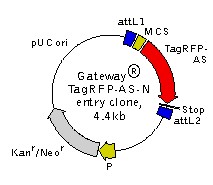
Gateway® TagRFP-AS-N entry clone is a vector containing red (orange) fluorescent protein TagRFP gene variant with codon usage optimized for high expression in Arabidopsis and Saccharomyces (see reporter description). TagRFP coding sequence is flanked by attL1 and attL2 sites allowing easy site-specific recombination. The Invitrogen Gateway® Technology provides a rapid and highly efficient way to transfer the TagRFP gene into a number of Gateway® destination vectors for expression in different experimental systems. Multiple cloning site (MCS) located at the 5'-end of TagRFP gene allows to generate fusions to the TagRFP N-terminus for expression, localization and cellular dynamics studies.
To increase mRNA translation efficiency, Kozak consensus translation initiation site is generated upstream of the TagRFP coding sequence [Kozak, 1987].
The vector backbone contains pUC origin of replication and kanamycin resistance gene (Kanr) for propagation and selection in
Generation of TagRFP fusion proteins
A localization signal or a gene of interest can be cloned into MCS of the vector both before and after site-specific recombination with a destination vector. It will be expressed as a fusion to the TagRFP N-terminus when inserted in the same reading frame as TagRFP and no in-frame stop codons are present.
Alternatively, TagRFP gene can be fused to the 3'-end of a gene of interest by LR recombination of the Gateway® TagRFP-AS-N with a destination vector containing this gene in a correct reading frame.
TagRFP-tagged fusions retain fluorescent properties of the native protein allowing fusion localization in vivo.
Note: The plasmid DNA was isolated from dam+-methylated
LR site-specific recombination
Please refer to Invitrogen Gateway® Technology description for detailed instructions regarding LR site-specific recombination reaction. In general, to transfer TagRFP gene or TagRFP-fusion construct into the destination vector you will need:
- Purified plasmid DNA of Gateway® TagRFP-AS-N
- A destination vector of choice
- Invitrogen LR ClonaseTM II enzyme mix (Invitrogen Cat.# 11791-020)
- Proteinase K solution (supplied with the LR ClonaseTM II enzyme mix)
- TE-Buffer, pH 8.0 (10 mM Tris-HCl, pH 8.0, 1 mM EDTA)
- Appropriate chemically competent
- Appropriate selective plates.
Propagation in
Suitable host strains for propagation in
Location of features
attL1 site: 14-113
MCS: 117-194
Kozak translation initiation site: 195-205
TagRFP-AS: 202-915
attL2 site: 934-1033
Kanamycin resistance gene: 2251-3045
pUC origin of replication: 3630-4273
References:
- Kozak M. An analysis of 5'-noncoding sequences from 699 vertebrate messenger RNAs. Nucleic Acids Res. 1987; 15 (20):8125-48. / pmid: 3313277
Notice to Purchaser:
TagRFP-related materials (also referred to as "Products") are intended for research use only. The Products are covered by U.S. Pat. 7,638,615; European Pat. 1994149; and other Evrogen Patents and/or Patent applications pending. By use of these Products, you accept the terms and conditions of the applicable Limited Use Label License.
Invitrogen Gateway® Technology: please see Limited Use Label License No. 19: Gateway® Cloning Products.
|
|
Copyright 2002-2023 Evrogen. All rights reserved. Evrogen JSC, 16/10 Miklukho-Maklaya str., Moscow, Russia, Tel +7(495)988-4084, Fax +7(495)988-4085, e-mail:evrogen@evrogen.com |