
|
||||||||||
|
||||||||||


|
|
||||||||||||||||||||||||||||||||||||||||||||||||||||
The vector sequence has been compiled using the information from sequence databases, published literature, and other sources, together with partial sequences obtained by Evrogen. This vector has not been completely sequenced. |
|||||||||||||||||||||||||||||||||||||||||||||||||
 Download
|
| ||||||||||||||||||||||||||||||||||||||||||||||||
Vector description
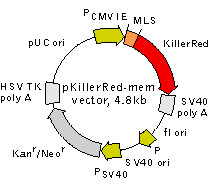
pKillerRed-mem is a mammalian expression vector encoding membrane-targeted KillerRed (see reporter description). KillerRed localized on cellular membrane can be used for effective light-induced cell killing.
Note: Comparing to the mitochondrially targeted KillerRed, irradiation of membrane-localized KillerRed leads to even more effective and fast cell death (within 10-30 min). Moreover, membrane-targeted KillerRed was shown to be suitable for the light induced cell killing within a developing zebrafish.
KillerRed codon usage is optimized for high expression in mammalian cells (humanized) [Haas et al., 1996]. Membrane localization signal (MLS) of neuromodulin is linked to the KillerRed N-terminus. The MLS (N-terminal 20 amino acid residues of neuromodulin) contains a signal for posttranslational palmitoylation of cysteines 3 and 4 that targets KillerRed to cellular membranes [Skene and Virag, 1989].
pKillerRed-mem vector can be used as a source of MLS-KillerRed hybrid sequence. The vector backbone contains unique restriction sites that permit its excision and further insertion into expression vector of choice.
Note: The plasmid DNA was isolated from dam+-methylated
The vector backbone contains immediate early promoter of cytomegalovirus (PCMV IE) for protein expression, SV40 origin for replication in mammalian cells expressing SV40 T-antigen, pUC origin of replication for propagation in
SV40 early promoter (PSV40) provides neomycin resistance gene (Neor) expression to select stably transfected eukaryotic cells using G418. Bacterial promoter (P) provides kanamycin resistance gene expression (Kanr) in
Expression in mammalian cells
pKillerRed-mem vector can be transfected into mammalian cells by any known transfection method. CMV promoter provides strong, constitutive expression of memrane-targeted KillerRed in eukaryotic cells. If required, stable transformants can be selected using G418 [Gorman, 1985].
Note: KillerRed shows no cell toxic effects before light activation. Upon green light irradiation KillerRed generates reactive oxygen species (ROS) that damage the neighboring molecules.
Propagation in
Suitable host strains for propagation in
Location of features
PCMV IE: 1-589
Enhancer region: 59-465
TATA box: 554-560
Transcription start point: 583
KillerRed-mem fusion
Start codon (ATG): 679-681
Neuromodulin N-terminal sequence (mem): 679-738
Start of KillerRed coding sequence: 739-741
Stop codon: 1450-1452
SV40 early mRNA polyadenylation signal
Polyadenylation signals: 1606-1611 & 1635-1640
mRNA 3' ends: 1644 & 1656
f1 single-strand DNA origin: 1703-2158
Bacterial promoter for expression of Kanr gene
-35 region: 2220-2225
-10 region: 2243-2248
Transcription start point: 2255
SV40 origin of replication: 2499-2634
SV40 early promoter
Enhancer (72-bp tandem repeats): 2332-2403 & 2404-2475
21-bp repeats: 2479-2499, 2500-2520 & 2522-2542
Early promoter element: 2555-2561
Major transcription start points: 2551, 2589, 2595 & 2600
Kanamycin/neomycin resistance gene
Neomycin phosphotransferase coding sequences:
Start codon (ATG): 2683-2685
Stop codon: 3475-3477
G->A mutation to remove Pst I site: 2865
C->A (Arg to Ser) mutation to remove BssH II site: 3211
Herpes simplex virus (HSV) thymidine kinase (TK) polyadenylation signal
Polyadenylation signals: 3713-3718 & 3726-3731
pUC plasmid replication origin: 4062-4705
References:
- Gorman C. High efficiency gene transfer into mammalian cells. In DNA cloning: A Practical Approach, Vol. II. Ed. D. M. Glover. (IRL Press, Oxford, U.K.). 1985; 143-90.
- Haas J, Park EC, Seed B. Codon usage limitation in the expression of HIV-1 envelope glycoprotein. Curr Biol. 1996; 6 (3):315-24. / pmid: 8805248
- Skene JH, Virag I. Posttranslational membrane attachment and dynamic fatty acylation of a neuronal growth cone protein, GAP-43. J Cell Biol. 1989; 108 (2):613-24. / pmid: 2918027
Notice to Purchaser:
KillerRed-related materials (also referred to as "Products") are intended for research use only.
|
|
Copyright 2002-2023 Evrogen. All rights reserved. Evrogen JSC, 16/10 Miklukho-Maklaya str., Moscow, Russia, Tel +7(495)988-4084, Fax +7(495)988-4085, e-mail:evrogen@evrogen.com |