|
Photoactivatable fluorescent proteins
- Light-induced high-contrast photoconversion
- Easy detection by flow cytometry or fluorescence microscopy
- No cofactors, substrates, or chemical staining required
- Suitability for long-term tracking of cellular events
Photoactivatable fluorescent proteins (PAFPs) represent a unique tool for monitoring cellular events. PAFPs change spectral properties in response to irradiation with specific light. In recent years PAFPs have been utilized for the development of novel methods for the optical labeling and tracking living cells, organelles, and intracellular molecules in a spatio-temporal manner. PAFPs became indispensible tools for super-resolution imaging techniques. Moreover, PAFPs opened new possibilities to study cell physiology, in particular, they allow careful determination of protein half-life.
|
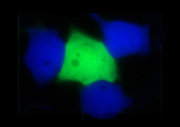 PS-CFP2
Monomeric
cyan-to-green
photoswitchable
fluorescent
protein:
|
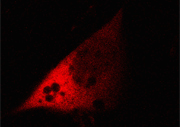 KFP-Red
Kindling
red
fluorescent
protein:
|
 PA-TagRFP
Monomeric
red
photoactivatable
fluorescent
protein:
|
|
- up to 2000-fold contrast of photoconversion
- high pH stability
|
- fluorescence is induced by green laser irradiation
- can be kindled reversibly or irreversibly
|
- irreversible photoactivation by UV-violet light irradiation
- high brightness and photostability
|
|
Available proteins
| CHARACTERISTIC |
PS-CFP2 | KFP-Red | PA-TagRFP |
* Brightness is a product of extinction coefficient and quantum yield, divided by 1000.
Ext.coeff. – extinction coefficient. |
|
|
|
|
|
|
| Fluorescence color | cyan / green |
NO / red |
NO / red |
| Excitation max (nm) | 400 / 490 |
580 / 580 |
- / 562 |
| Emission max (nm) | 468 / 511 |
600 / 600 |
- / 595 |
| Quantum yield | 0.20 / 0.23 |
<0.001 / 0.07 |
nd / 0.38 |
| Ext. coeff. (M-1cm-1) | 43 000 / 47 000 |
123 000 / 59 000 |
nd / 66 000 |
| Brightness* | 8.6 / 10.8 |
0 / 4.1 |
0 / 25.1 |
| Activating light | UV-violet (e.g. 405 nm) |
green (530-560 nm) |
UV-violet (e.g. 390-420 nm) |
| Calculated contrast, fold | up to 2000 |
35-70 |
~540 |
| Structure | monomer |
tetramer |
monomer |
| Cell toxicity | not observed |
not observed |
not observed |
| Aggregation | no |
no |
no |
| Maturation rate at 37°C | fast |
medium |
fast |
| Molecular weight (kDa) | 27 |
26 |
27 |
Discontinued proteins: Dendra2
|