pJRed-C


pJRed-C vector

cat.# FP701

The vector sequence has been compiled using the information from sequence databases, published literature, and other sources, together with partial sequences obtained by Evrogen. This vector has not been completely sequenced.


Download
vector information:
ProductCat.#SizePrice
pJRed-CFP70120 μg€ 400.00
The price does not include delivery. The price varies in different countries. Please contact your local distributor for exact prices and delivery information.

Vector typemammalian expression vector
ReporterJRed
Reporter codon usagemammalian
Promoter for JRedPCMV IE
Host cellsmammalian
Selectionprokaryotic - kanamycin
eukaryotic - neomycin (G418)
Replicationprokaryotic - pUC ori
eukaryotic - SV40 ori
Use JRed expression in mammalian cells; generation of fusions to the JRed C-terminus
Multiple cloning site (MCS)
JRed Bgl II Sac I EcoR I Sal I Kpn I Apa I BamH I Stops
BspE I Xho I Hind III Pst I Sac II Sma I/Xma I Xba I# Bcl I#
GAG.GAT. TCC.GGA. CTC. AGA.T CT .C GA.G CT.C AA.GCT.T C G.AAT.T C T.GCA. G TC.GAC .GGT.A CC. GC G.G G C.CC G. GG A.TCC. ACC.GGA. TC T.AG A. TAA. C TG.A TC.A

# - sites are blocked by dam methylation. If you wish to digest the vector with these enzymes, you will need to transform the vector into a dam- host and make fresh DNA.

Vector description

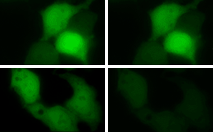
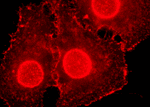
pJRed-C is a mammalian expression vector encoding true-red fluorescent protein JRed (see protein description). The vector allows generation of fusions to the JRed C-terminus and expression of JRed fusions or JRed alone in eukaryotic (mammalian) cells.

JRed codon usage is optimized for high expression in mammalian cells (humanized) [Haas et al., 1996]. To increase mRNA translation efficiency, Kozak consensus translation initiation site is generated upstream of the JRed sequence [Kozak, 1987]. Multiple cloning site (MCS) is located between JRed coding sequence and SV40 polyadenylation signal (SV40 polyA).

The vector backbone contains immediate early promoter of cytomegalovirus (PCMV IE) for protein expression, SV40 origin for replication in mammalian cells expressing SV40 T-antigen, pUC origin of replication for propagation in E. coli, and f1 origin for single-stranded DNA production. SV40 polyA direct proper processing of the 3'-end of the reporter mRNA.

SV40 early promoter (PSV40) provides neomycin resistance gene (Neor) expression to select stably transfected eukaryotic cells using G418. Bacterial promoter (P) provides kanamycin resistance gene expression (Kanr) in E. coli. Kanr/Neor gene is linked with herpes simplex virus (HSV) thymidine kinase (TK) polyadenylation signals.


Generation of JRed-fusion proteins

A localization signal (or a gene of interest) should be cloned into MCS of the vector. It will be expressed as a fusion to the JRed C-terminus when inserted in the same reading frame as JRed and no intervening stop codons are present. JRed-tagged fusions retain fluorescent properties of the native protein allowing fusion localization in vivo. Unmodified vector will express JRed, when transfected into eukaryotic (mammalian) cells.

Note: The plasmid DNA was isolated from dam+-methylated E.coli. Therefore some restriction sites are blocked by methylation. If you wish to digest the vector using such sites you will need to transform the vector into a dam- host and make fresh DNA.


Expression in mammalian cells

pJRed-C can be transfected into mammalian cells by any known transfection method. CMV promoter provides strong, constitutive expression of JRed or its fusions in many cell types. If required, stable transformants can be selected using G418 [Gorman, 1985].


Propagation in E. coli

Suitable host strains for propagation in E. coli include DH5alpha, HB101, XL1-Blue, and other general purpose strains. Plasmid incompatibility group is pMB1/ColE1. The vector confers resistance to kanamycin (30 μg/ml) to E. coli hosts. Copy number in E. coli is about 500.


Location of features

PCMV IE: 1-589
Enhancer region: 59-465
TATA box: 554-560
Transcription start point: 583
JRed
Kozak consensus translation initiation site: 606-616
Start codon (ATG): 613-615
Stop codon: 1417-1419
Last amino acid in JRed: 1336-1338
MCS: 1339-1424
SV40 early mRNA polyadenylation signal
Polyadenylation signals: 1559-1564 & 1588-1593
mRNA 3' ends: 1597 & 1609
f1 single-strand DNA origin: 1656-2111
Eukaryotic promoter for expression of Kanr gene
-35 region: 2173-2178
-10 region: 2196-2201
Transcription start point: 2208
SV40 origin of replication: 2452-2587
SV40 early promoter
Enhancer (72-bp tandem repeats): 2285-2356 & 2357-2428
21-bp repeats: 2432-2452, 2453-2473 & 2475-2495
Early promoter element: 2508-2514
Major transcription start points: 2504, 2542, 2548 & 2553
Kanamycin/neomycin resistance gene
Neomycin phosphotransferase coding sequences:
Start codon (ATG): 2636-2638
Stop codon: 3428-3430
G->A mutation to remove Pst I site: 2818
C->A (Arg to Ser) mutation to remove BssH II site: 3164
Herpes simplex virus (HSV) thymidine kinase (TK) polyadenylation signal
Polyadenylation signals: 3666-3671 & 3679-3684
pUC plasmid replication origin: 4015-4658


References:

  • Gorman C. High efficiency gene transfer into mammalian cells. In DNA cloning: A Practical Approach, Vol. II. Ed. D. M. Glover. (IRL Press, Oxford, U.K.). 1985; 143–90.
  • Haas J, Park EC, Seed B. Codon usage limitation in the expression of HIV-1 envelope glycoprotein. Curr Biol. 1996; 6 (3):315-24. / pmid: 8805248
  • Kozak M. An analysis of 5'-noncoding sequences from 699 vertebrate messenger RNAs. Nucleic Acids Res. 1987; 15 (20):8125-48. / pmid: 3313277

Notice to Purchaser:

Evrogen FP-related products are intended for research use only and covered by Evrogen Patents and/or Patent applications pending. By use of these products, you accept the terms and conditions of the applicable Limited Use Label License.

The CMV promoter is covered under U.S. Patents 5,168,062 and 5,385,839, and its use is permitted for research purposes only. Any other use of the CMV promoter requires a license from the University of Iowa Research Foundation, 214 Technology Innovation Center, Iowa City, IA 52242.

MATERIAL SAFETY DATA SHEET INFORMATION

To the best of our knowledge, these products do not require a Material Safety Data Sheet. However, all the properties of these products (and, if applicable, each of their components) have not been thoroughly investigated. Therefore, we recommend that you use gloves and eye protection, and wear a laboratory coat when working with these products.

Copyright 2002-2008 Evrogen. All rights reserved.
Evrogen JSC, 16/10 Miklukho-Maklaya str., Moscow, Russia, +7(495)4298020, e-mail:evrogen@evrogen.com