|
||||||||
![]() |
||||||||
![]() |
![]() |
![]() |
![]() |
![]() |
![]() |
![]() |
![]() |
![]() |
|
|
||||||||||||||||||||||||||||||||||||||||||||||||||||||
The vector sequence has been compiled using the information from sequence databases, published literature, and other sources, together with partial sequences obtained by Evrogen. This vector has not been completely sequenced. |
|||||||||||||||||||||||||||||||||||||||||||||||||
![]() Download
|
| ||||||||||||||||||||||||||||||||||||||||||||||||
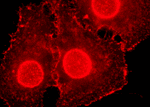
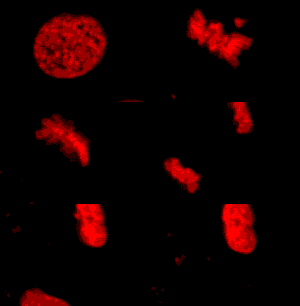
pmKate2-profilin is a mammalian expression vector encoding mKate2-profilin fusion protein (see reporter description). The vector can be used for fluorescent labeling of profilin in living cells.
![]() | Expression of mKate2 fusion with profilin in HeLa cells.Scale bar represents 10 μm. |
mKate2 codon usage is optimized for high expression in mammalian cells (humanized) [Haas et al., 1996]. Mouse profilin is fused to the mKate2 C-terminus. To increase mRNA translation efficiency, Kozak consensus translation initiation site is generated upstream of the mKate2-profilin coding sequence [Kozak, 1987].
pmKate2-profilin vector can be used as a source of mKate2-profilin hybrid sequence. The vector backbone contains unique restriction sites that permit its excision and further insertion into expression vector of choice.
Note: The plasmid DNA was isolated from dam+-methylated
The vector backbone contains immediate early promoter of cytomegalovirus (PCMV IE) for protein expression, SV40 origin for replication in mammalian cells expressing SV40 T-antigen, pUC origin of replication for propagation in
SV40 early promoter (PSV40) provides neomycin resistance gene (Neor) expression to select stably transfected eukaryotic cells using G418. Bacterial promoter (P) provides kanamycin resistance gene expression (Kanr) in
Expression in mammalian cells
pmKate2-profilin vector can be transfected into mammalian cells by any known transfection method. CMV promoter provides strong, constitutive expression of the mKate2-profilin fusion in eukaryotic cells. If required, stable transformants can be selected using G418 [Gorman, 1985].
Propagation in
Suitable host strains for propagation in
Location of features
PCMV IE: 1-589
Enhancer region: 59-465
TATA box: 554-560
Transcription start point: 583
mKate2-profilin fusion: 613-1764
mKate2: 613-1314
Start codon (ATG): 613-615
Last amino acid in mKate2: 1312-1314
Profilin: 1345-1764
Stop codon: 1765-1767
SV40 early mRNA polyadenylation signal
Polyadenylation signals: 1928-1933 & 1957-1962
mRNA 3' ends: 1966 & 1978
f1 single-strand DNA origin: 2025-2480
Bacterial promoter for expression of Kanr gene
-35 region: 2542-2547
-10 region: 2565-2570
Transcription start point: 2577
SV40 origin of replication: 2821-2956
SV40 early promoter
Enhancer (72-bp tandem repeats): 2654-2725 & 2726-2797
21-bp repeats: 2801-2821, 2822-2842 & 2844-2864
Early promoter element: 2877-2883
Major transcription start points: 2873, 2911, 2917 & 2922
Kanamycin/neomycin resistance gene
Neomycin phosphotransferase coding sequences:
Start codon (ATG): 3005-3007
Stop codon: 3797-3799
G->A mutation to remove Pst I site: 3187
C->A (Arg to Ser) mutation to remove BssH II site: 3533
Herpes simplex virus (HSV) thymidine kinase (TK) polyadenylation signal
Polyadenylation signals: 4035-4040 & 4048-4053
pUC plasmid replication origin: 4384-5027
Evrogen Fluorescent Protein Products (the Products) are intended for research use only. The Products are covered by Evrogen Patents and/or Patent applications pending. By use of these Products, you accept the terms and conditions of the applicable Limited Use Label License.
The CMV promoter is covered under U.S. Patents 5,168,062 and 5,385,839, and its use is permitted for research purposes only. Any other use of the CMV promoter requires a license from the University of Iowa Research Foundation, 214 Technology Innovation Center, Iowa City, IA 52242.
|
Copyright 2002-2011 Evrogen. All rights reserved. Evrogen JSC, 16/10 Miklukho-Maklaya str., Moscow, Russia, Tel +7(495)988-4084, Fax +7(495)988-4085, e-mail:evrogen@evrogen.com |