
|
||||||||||
|
||||||||||


TurboFP635
SUPPORTRESOURCES |
|
||||||||||||||||||||||||||||||||||||||||||||||||||||||||||||||||
 |
TurboFP635 (scientific name Katushka) is a far-red mutant of the red fluorescent protein from sea anemone Entacmaea quadricolor [Shcherbo et al., 2007]. Possessing excitation/emission maxima at 588/635 nm, TurboFP635 is 7 to 10-fold brighter compared to the spectrally close HcRed [Gurskaya et al., 2001] or mPlum [Wang et al., 2004]. TurboFP635 is characterized by fast maturation and a high pH-stability and photostability. The unique characteristics of TurboFP635 make it the protein of choice for visualization within living tissues and dual-color high-throughput assays. TurboFP635 is mainly intended for applications where fast appearance of far-red fluorescence is crucial. It is specially recommended for multicolor imaging, tracking the promoter activity in auto-fluorescent tissues, cell and organelle labeling. |

Main properties
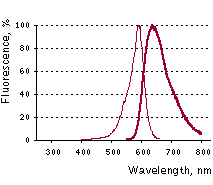
TurboFP635 normalized excitation (thin line) and emission (thick line) spectra. |
| ||||||||||||||||||||||||||||||||||||||
|---|---|---|---|---|---|---|---|---|---|---|---|---|---|---|---|---|---|---|---|---|---|---|---|---|---|---|---|---|---|---|---|---|---|---|---|---|---|---|---|
Recommended filter sets and antibodies
TurboFP635 can be recognized using Anti-tRFP antibody (Cat.# AB233) available from Evrogen.
Recommended Omega Optical filter sets are QMAX-Red and XF102-2. TurboFP635 can also be detected using Texas Red filter sets or similar.
Performance and use
TurboFP635 can be easily expressed and detected in a wide range of organisms. Mammalian cells transiently transfected with TurboFP635 expression vectors produce bright fluorescence in 10-12 hrs after transfection. No cytotoxic effects or visible protein aggregation are observed.
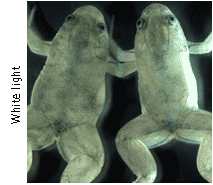 | 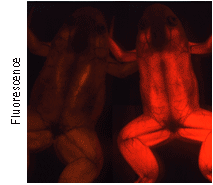 | DsRed-Express and TurboFP635 expression in Xenopus laevis.Transgenic 2.5 months living animals expressing TurboFP635 and DsRed-Express under the control of cardiac actin promoter are shown from the dorsal side. TurboFP635 (on the right) is excellently visible in the whole body, while DsRed-Express (on the left) can be hardly visualized. This experiment clearly demonstrates the advantage of longer wavelength emission of TurboFP635 for the whole body imaging. Leica MZFLIII fluorescent stereomicroscope, excitation filter 546/10; emission filter 565LP. Data courtesy of Dr. A. Zaraisky, Institute of Bioorganic Chemistry, RAS (Moscow, Russia). |
|---|
Despite its dimeric structure, TurboFP635 performs well in some fusions. However, for protein labeling applications we recommend using specially optimized monomeric TagFPs.
TurboFP635 suitability to generate stably transfected cells has been proven by Marinpharm company.
TurboFP635 can be used in multicolor labeling applications with blue, cyan, green, yellow, and red (orange) fluorescent dyes.
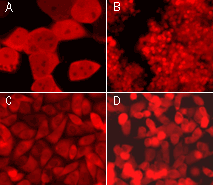 | TurboFP635 expression in mammalian cells.(A) Transiently transfected Phoenix cells; (B) stably transfected WALKER 256 rat tumor cells; (C) stably transfected T-24 human bladder carcinoma cells; (D) stably transfected metastasizing melanoma line MelJuSo. Images of stably transfected cell lines were kindly provided by Dr. Christian Petzelt (Marinpharm). |
|---|
| Variant | Description | Related vector | Cat.# | |
|---|---|---|---|---|
| ||||
| Humanized TurboFP635 | TurboFP635 codon usage is optimized for high expression in mammalian cells [Haas et al., 1996], but it can be successfully expressed in many other heterological systems. Evrogen mammalian expression vectors comprising multiple cloning sites at the 5’- or 3’-end of TurboFP635 coding sequence allow easy generation of fusions of interest. |
|
FP721 | |
|
|
FP722 | |||
References:
- Gurskaya NG, Fradkov AF, Terskikh A, Matz MV, Labas YA, Martynov VI, Yanushevich YG, Lukyanov KA, Lukyanov SA. GFP-like chromoproteins as a source of far-red fluorescent proteins. FEBS Lett. 2001; 507 (1):16-20. / pmid: 11682051
- Haas J, Park EC, Seed B. Codon usage limitation in the expression of HIV-1 envelope glycoprotein. Curr Biol. 1996; 6 (3):315-24. / pmid: 8805248
- Shcherbo D, Merzlyak EM, Chepurnykh TV, Fradkov AF, Ermakova GV, Solovieva EA, Lukyanov KA, Bogdanova EA, Zaraisky AG, Lukyanov S, Chudakov DM. Bright far-red fluorescent protein for whole-body imaging. Nat Methods. 2007; 4 (9):741-6. / pmid: 17721542
- Wang L, Jackson WC, Steinbach PA, Tsien RY. Evolution of new nonantibody proteins via iterative somatic hypermutation. Proc Natl Acad Sci U S A. 2004; 101 (48):16745-9. / pmid: 15556995
|
|
Copyright 2002-2023 Evrogen. All rights reserved. Evrogen JSC, 16/10 Miklukho-Maklaya str., Moscow, Russia, Tel +7(495)988-4084, Fax +7(495)988-4085, e-mail:evrogen@evrogen.com |