|
Yellow fluorescent protein TurboYFP
- Super bright true-yellow fluorescence
- Emission wavelength is ideally positioned between those of green and red fluorescent proteins
- Fast maturation, high pH-stability and photostability
- Destabilized variant is available
- Recommended for gene expression analysis and cell labeling
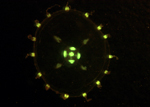 |
TurboYFP is an enhanced variant of the yellow fluorescent protein PhiYFP from jellyfish Phialidium sp. [Shagin et al., 2004]. It possesses superbright yellow fluorescence with emission maximum at 538 nm and is ideally positioned between green and red fluorescent proteins, allowing easy separation from these markers by flow cytometry using common channels of detection and a single laser excitation line. Compared with Phi-Yellow proteins, TurboYFP matures faster in mammalian cells.
TurboYFP is mainly intended for applications where fast appearance of bright fluorescence is crucial. It is specially recommended for cell labeling and tracking the promoter activity. Destabilized TurboYFP variant allows analysis of rapid and/or transient events in gene regulation.
|
Main properties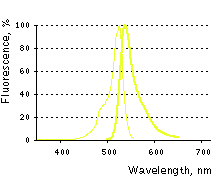
TurboYFP normalized excitation (thin line) and emission (thick line) spectra.
Spectra viewer tool
Download TurboYFP spectra (xls)
| | CHARACTERISTIC | |
|---|
* Brightness is a product of extinction coefficient and quantum yield, divided by 1000.
| | Molecular weight, kDa | 26 | | Polypeptide length, aa | 234 | | Fluorescence color | yellow | | Excitation maximum, nm | 525 | | Emission maximum, nm | 538 | | Quantum yield | 0.53 | | Extinction coefficient, M-1cm-1 | 105 000 | | Brightness* | 55.7 | | Brightness, % of EGFP | 169 | | pKa | 5.9 | | Structure | dimer | | Aggregation | at high concentrations | | Maturation rate at 37°C | super fast | | Photostability | high | | Cell toxicity | at high concentrations | | Main advantages | superbright and fast-maturing yellow fluorescent protein | | Possible limitations | dimer, limited applicability for fusions generation; can form aggregates at high concentration |
|
|---|
Recommended filter sets and antibodies
TurboYFP can be recognized using Anti-TurboYFP (Cat.# AB605) antibodies available from Evrogen.
TurboYFP can be detected using Omega Optical filter set XF104-3 or Chroma Technology Corp. filter set 42003 ("ZsYellow1").
Performance and use
TurboYFP can be expressed and detected in a wide range of organisms. Mammalian cells transiently transfected with TurboYFP expression vectors produce bright fluorescence in 8-10 hrs after transfection.
Being overexpressed in long-term culture of cells with high expression levels, TurboYFP shows slight tendency to aggregate. It might limit TurboYFP use in such experimental systems. Please use Phi-Yellow proteins for stable expression and for organelle labeling.
Despite its dimeric structure, TurboYFP performs well in some fusions. However for protein labeling applications we recommend using specially optimized monomeric TagFPs.
TurboYFP can be used in multicolor labeling applications with blue, cyan, green, red, and far-red fluorescent dyes.
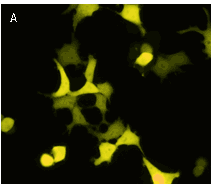 | 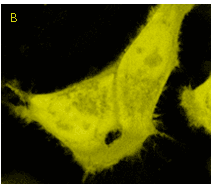 | TurboYFP expression in transiently transfected cells:
(A) Phoenix cells; (B) Hela cells.
|
|---|
Available variants and fusions
| Variant | Description | Related vector | Cat.# |
|---|
|
|
Humanized TurboYFP
|
TurboYFP codon usage is optimized for high expression in mammalian cells [Haas et al., 1996], but it can be successfully expressed in many other heterological systems.
|
pTurboYFP-N
|
FP612
|
|
pTurboYFP-B
|
FP613
|
|
Destabilized TurboYFP variant (TurboYFP-dest1)
|
TurboYFP-dest1 is produced by fusing the initial protein with PEST amino acid sequence encoded by region 422-461 of mouse ornithine decarboxylase gene [Li et al., 1998]. This sequence targets the protein to degradation and enables a rapid protein turnover. TurboYFP-dest1 retains spectral properties of the initial protein, but has shorter half-life (approximately 2 hrs) as measured by the analysis of fluorescence intensity of cells treated with a protein synthesis inhibitor, cycloheximide. Because of rapid turnover, TurboYFP-dest1 can be used to measure changes in gene expression.
|
peTurboYFP-dest1
|
FP617
|
References:
-
Haas J, Park EC, Seed B.
Codon usage limitation in the expression of HIV-1 envelope glycoprotein.
Curr Biol. 1996; 6 (3):315-24. / pmid: 8805248
-
Li X, Zhao X, Fang Y, Jiang X, Duong T, Fan C, Huang CC, Kain SR.
Generation of destabilized green fluorescent protein as a transcription reporter.
J Biol Chem. 1998; 273 (52):34970-5. / pmid: 9857028
-
Shagin DA, Barsova EV, Yanushevich YG, Fradkov AF, Lukyanov KA, Labas YA, Semenova TN, Ugalde JA, Meyers A, Nunez JM, Widder EA, Lukyanov SA, Matz MV.
GFP-like proteins as ubiquitous metazoan superfamily: evolution of functional features and structural complexity.
Mol Biol Evol. 2004; 21 (5):841-50. / pmid: 14963095
|