|
Far-red fluorescent protein TagFP635
- Bright far-red fluorescence
- Monomer with successful performance in fusions
- High photostability
- Fluorescent signal is easily distinguished from background fluorescence
- Recommended for protein labeling
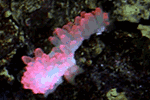
 | TagFP635 (scientific name mKate) is a monomeric far-red fluorescent protein generated from the wild-type RFP from sea anemone Entacmaea quadricolor [Shcherbo et al., 2007]. It possesses bright fluorescence with excitation/emission maxima at 588 and 635 nm, respectively.
TagFP635 is 6.4-fold brighter than mPlum, 1.25-fold brighter and much more photostable than mRaspberry [Shcherbo et al., 2007; Shaner et al., 2004]. This makes it the best monomeric far-red fluorescent protein available so far.
TagFP635 is mainly intended for protein labeling. It fluorescence allows easy and reliable separation from standard green fluorescent labels in dual-color high-throughput assays. TagFP635 can also be used for cell and organelle labeling and for tracking the promoter activity; however, TurboFP635 is preferable for these applications as it is brighter and more pH-stable than TagFP635. |
Related products| PRODUCT | CAT.# | DESCRIPTION | SIZE | PRICE | | The prices do not include delivery. The prices vary in different countries. Please contact your local distributor for exact prices and delivery information. |
|
| TagFP635 expression/source vectors |
|
|
|---|
| pTagFP635-C | FP161 | Mammalian expression vector encoding humanazied TagFP635 and allowing its expression and generation of fusions to the TagFP635 C-terminus | 20 μg | € 400.00 | | pTagFP635-N | FP162 | Mammalian expression vector encoding humanazied TagFP635 and allowing its expression and generation of fusions to the TagFP635 N-terminus | 20 μg | € 400.00 | | pTagFP635-actinin | FP380 | Mammalian expression vector encoding humanazied TagFP635 fused with human α-actinin | 20 μg | € 400.00 | | pTagFP635-clathrin | FP381 | Mammalian expression vector encoding humanazied TagFP635 fused with human clathrin light chain LCB | 20 μg | € 400.00 | | pTagFP635-Cx26 | FP382 | Mammalian expression vector encoding humanazied TagFP635 fused with rat connexin 26 | 20 μg | € 400.00 | | pTagFP635-Cx32 | FP383 | Mammalian expression vector encoding humanazied TagFP635 fused with human connexin 32 | 20 μg | € 400.00 | | pTagFP635-Cx43 | FP384 | Mammalian expression vector encoding humanazied TagFP635 fused with rat connexin 43 | 20 μg | € 400.00 | | pTagFP635-EB3 | FP385 | Mammalian expression vector encoding humanazied TagFP635 fused with human EB3 protein | 20 μg | € 400.00 | | pTagFP635-H2B | FP386 | Mammalian expression vector encoding humanazied TagFP635 fused with human histone H2B | 20 μg | € 400.00 | | pTagFP635-laminB1 | FP387 | Mammalian expression vector encoding humanazied TagFP635 fused with human lamin B1 | 20 μg | € 400.00 | | pTagFP635-vinculin | FP388 | Mammalian expression vector encoding humanazied TagFP635 fused with human vinculin | 20 μg | € 400.00 | | pTagFP635-zyxin | FP389 | Mammalian expression vector encoding humanazied TagFP635 fused with human zyxin | 20 μg | € 400.00 | | pTagFP635-actin | FP390 | Mammalian expression vector encoding humanazied TagFP635 fused with human cytoplasmic β-actin | 20 μg | € 400.00 | | pTagFP635-tubulin | FP391 | Mammalian expression vector encoding humanazied TagFP635 fused with human α-tubulin | 20 μg | € 400.00 |
|
| Antibody against TagFP635 |
|
|
|---|
| Anti-tRFP antibody | AB231 | Rabbit polyclonal antibody against TurboRFP, TurboFP602, TurboFP635, TagRFP, and TagFP635 | 100 μg | € 150.00 | | AB232 | 200 μg | € 200.00 |
References:
- Shaner NC, Campbell RE, Steinbach PA, Giepmans BN, Palmer AE, Tsien RY. Improved monomeric red, orange and yellow fluorescent proteins derived from Discosoma sp. red fluorescent protein. Nat Biotechnol. 2004; 22 (12):1567-72. / pmid: 15558047
- Shcherbo D, Merzlyak EM, Chepurnykh TV, Fradkov AF, Ermakova GV, Solovieva EA, Lukyanov KA, Bogdanova EA, Zaraisky AG, Lukyanov S, Chudakov DM. Bright far-red fluorescent protein for whole-body imaging. Nat Methods. 2007; 4 (9):741-6. / pmid: 17721542
|